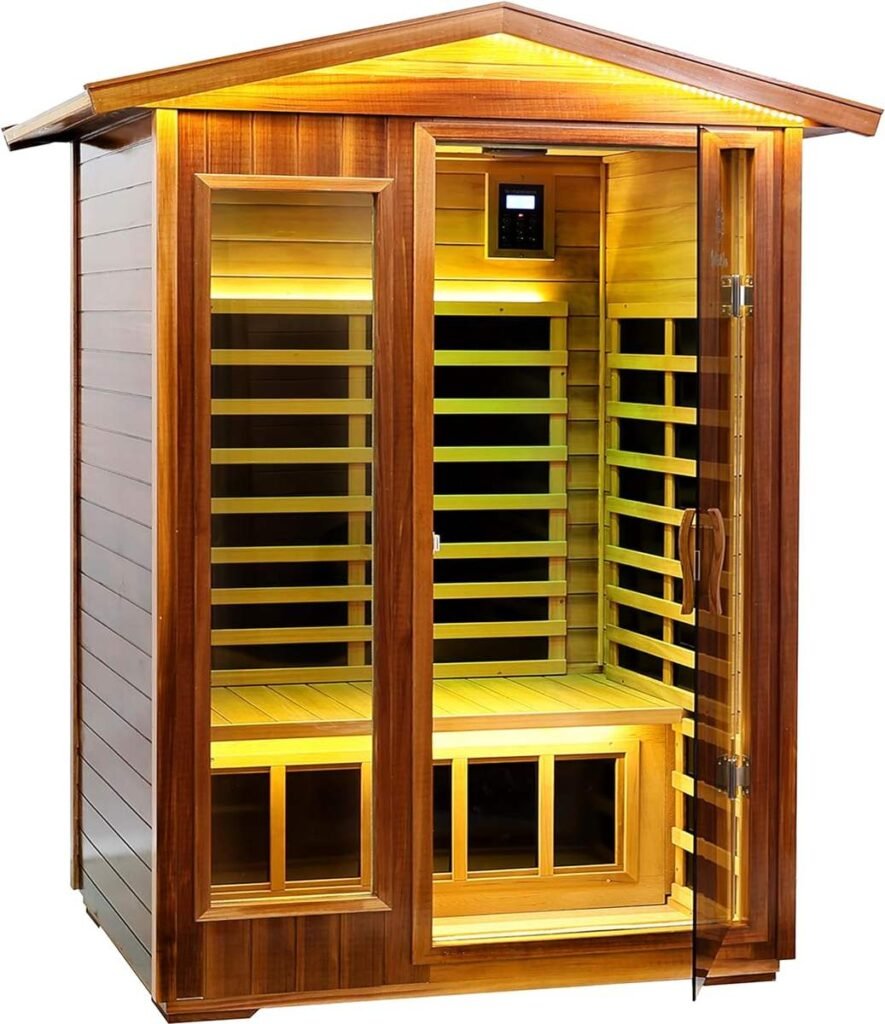
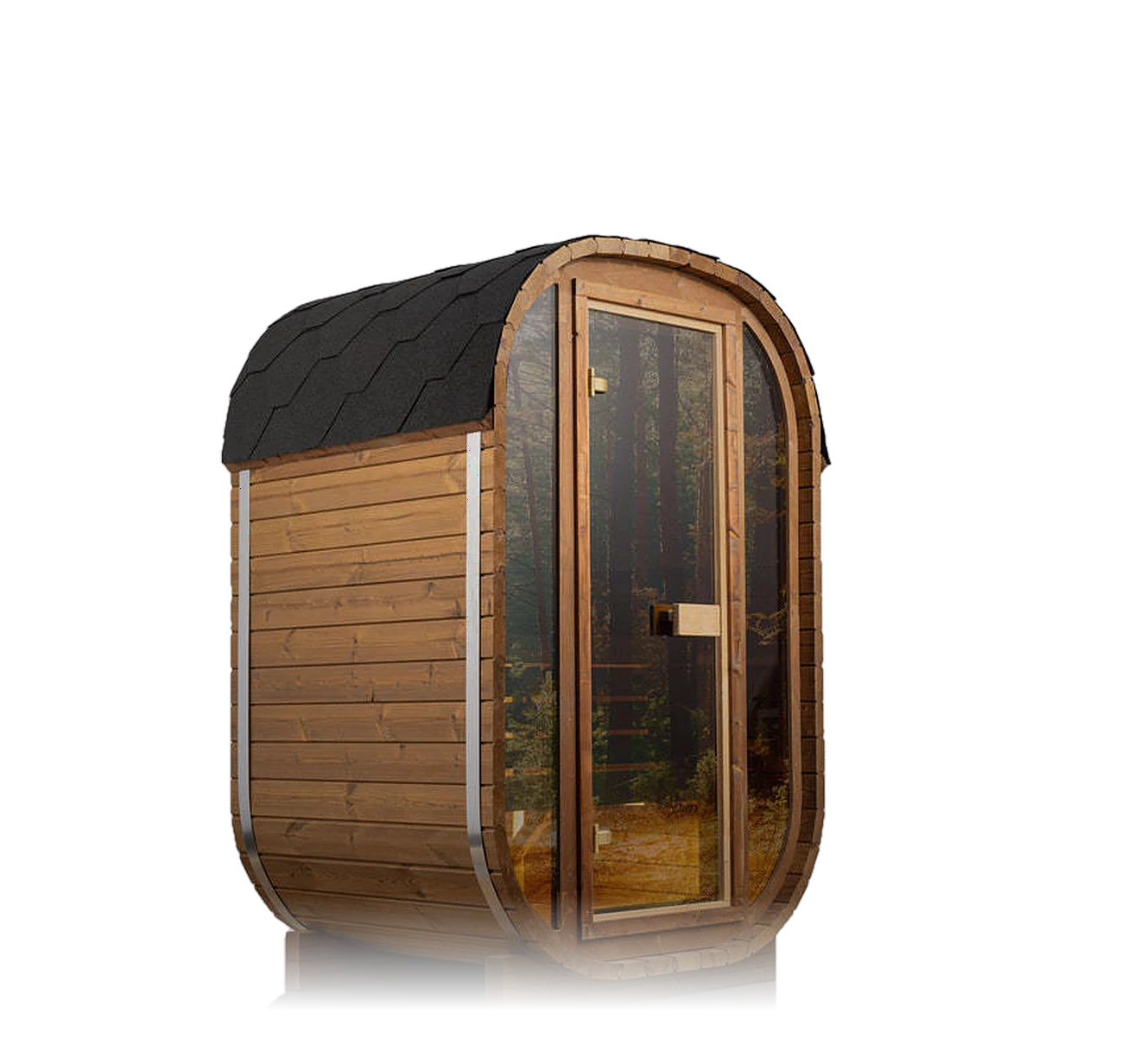
Most people buying a sauna are comparing cabins on price, wood, and the number of people it seats. Those are the easiest things to compare and among the least predictive of whether you will still be using it in three years.
The purchases that disappoint usually fail for one of three reasons: the cabin was too large for the circuit available, the room it went into could not handle the heat and moisture it produced, or it was bought on a marketing figure that describes nothing measurable. The specifications below are the ones that decide those outcomes.
Why buyers consider Infrared Saunas
- A private heat session at home removes the travel, the booking, and the per-visit cost that stop most people using a facility sauna consistently. Consistency is the variable most research depends on.
- Infrared cabins operate at lower air temperatures than a traditional sauna — typically around 120–150°F rather than 160–200°F — which many people find easier to tolerate for a longer session.
- They need no plumbing, no water supply, and no drain, which makes them the least invasive heat option to retrofit into an existing room.
- Assembly is generally modular. Most residential cabins arrive as panels and are built in place, which matters when the destination room is upstairs or through a narrow doorway.
What to compare before buying
- Infrared versus traditional sauna
- These are different appliances. A traditional sauna heats the air with a stove, reaching much higher air temperatures and allowing water on hot stones for humidity. An infrared cabin uses emitters that warm the body more directly at a lower air temperature. Both produce a heat load, but the experience, the electrical demand, and the room requirements differ. Most of the widely cited sauna research studied traditional Finnish saunas, not infrared cabins — a distinction manufacturers rarely draw.
- Emitter type and placement
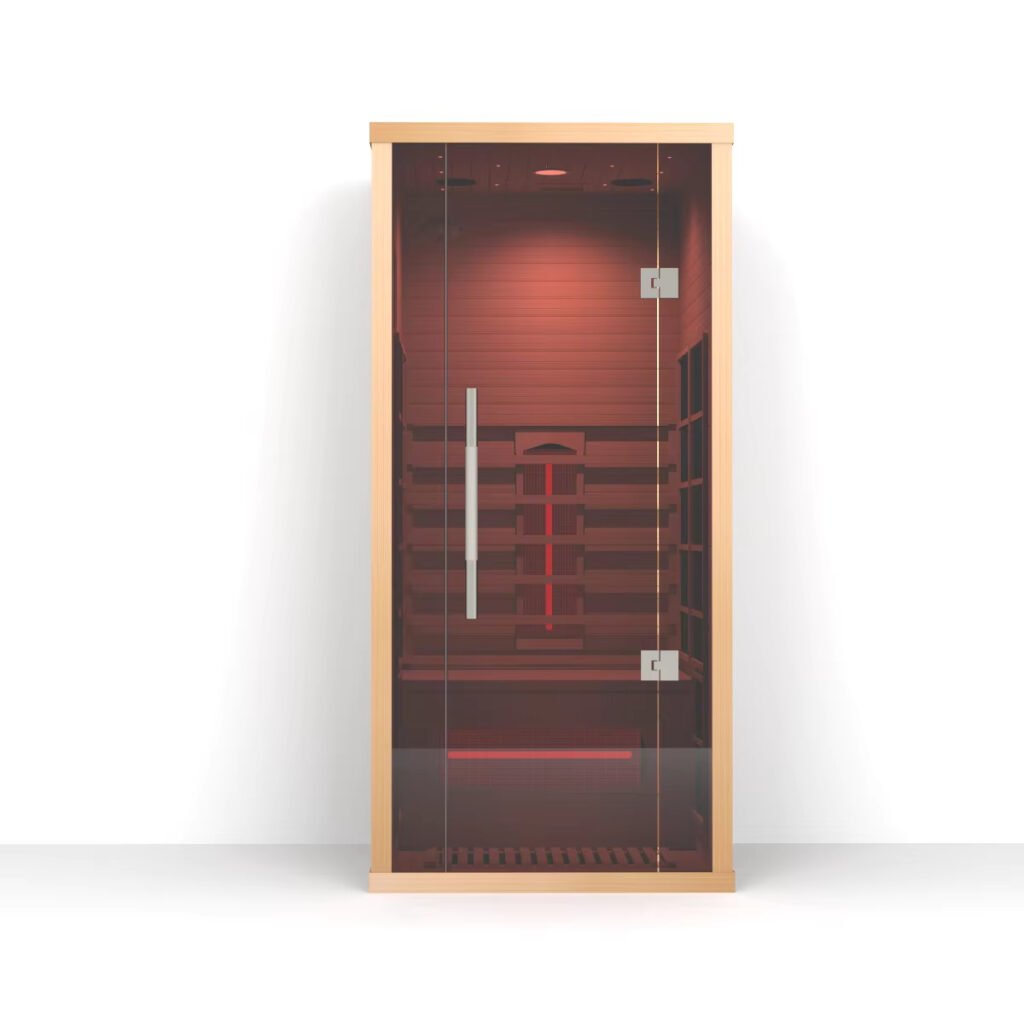
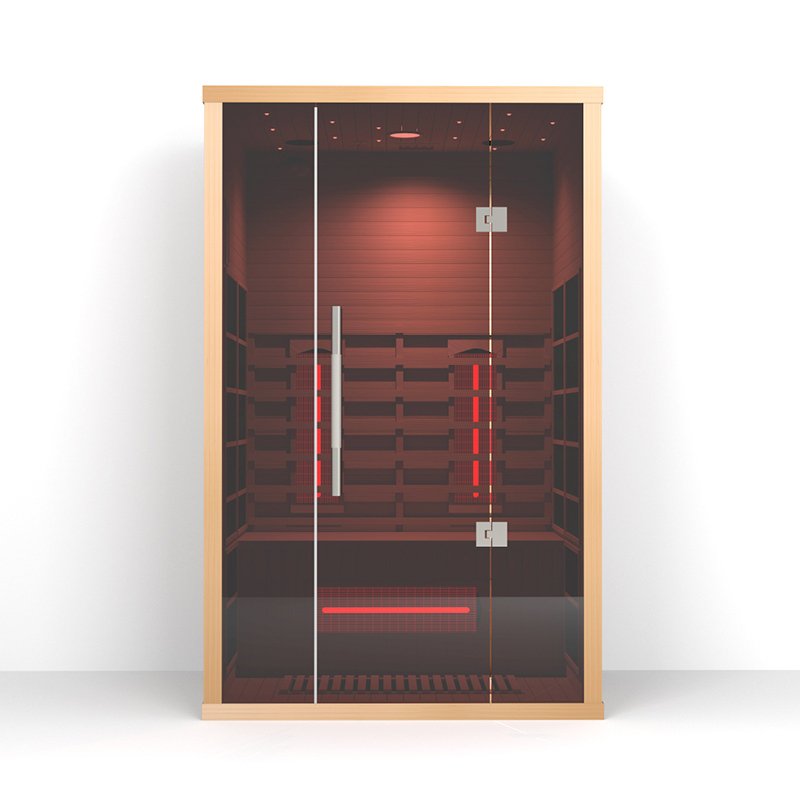
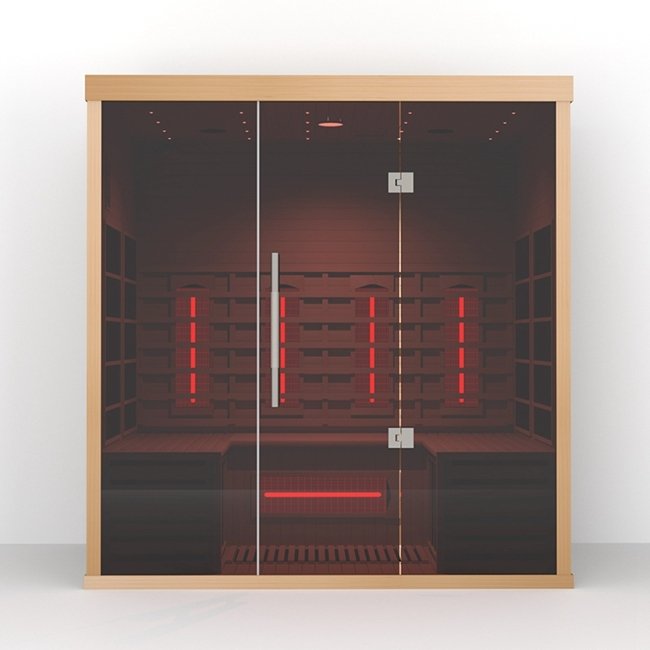
- Far-infrared emitters are the most common. Full-spectrum cabins add near and mid-infrared emitters. What matters more than the label is where the emitters are: a cabin with emitters only behind the bench heats you very differently from one with front, side, calf, and floor coverage. Ask for an emitter layout diagram rather than a count.
- Cabin size versus usable space
- A "two person" cabin is frequently a comfortable one-person cabin. Interior bench length and interior height are the honest measurements. If anyone using it is over about six feet, check interior height and bench depth specifically, because sitting upright with your head clear of the ceiling is what determines whether a session is pleasant.
- Materials and construction
- Cabins are commonly built in cedar, hemlock, basswood, or poplar. Cedar is naturally aromatic and rot-resistant; some people find the scent too strong in a small enclosed cabin, and basswood or poplar are the usual low-odour alternatives. Check panel thickness and whether joinery is tongue-and-groove, because that is what keeps the cabin tight and quiet as the wood moves through heat cycles.
- "Low EMF" claims
- There is no single standard behind this phrase, so the label alone tells you nothing. A manufacturer willing to publish measured field readings, the distance the measurement was taken at, and the method used is giving you something you can compare. One that only prints the words is not.
The specifications that actually matter
- Voltage and amperage draw
- The single most important number and the one most often discovered too late. Smaller cabins commonly run on a standard 120V circuit; larger and full-spectrum cabins frequently require a dedicated 20A circuit or a 240V supply. Get the exact requirement in writing before you buy, then have a licensed electrician confirm what your room can actually provide.
- Interior dimensions and interior height
- Exterior footprint tells you whether it fits the room. Interior dimensions tell you whether it fits you.
- Assembled weight and floor loading
- Relevant on upper floors and timber-framed structures. Ask for assembled weight, not shipping weight.
- Maximum operating temperature and heat-up time
- Heat-up time decides whether the sauna fits into a weekday evening. A cabin that takes 45 minutes to reach temperature gets used less than one that takes 15.
- Control system
- Look for accessible controls, a reliable timer, and a documented way to service or replace the controller. Bluetooth speakers and colour-changing lights are not specifications.
Space and installation
- Measure the delivery path, not just the destination: doorways, stair turns, ceiling height, and any tight corner. Panels are large and rigid.
- Leave the manufacturer-specified clearance on every side. Cabins need air movement around them, and the clearance figure is a safety requirement rather than a suggestion.
- Allow room for the door to open fully, and for someone to get in and out comfortably while the cabin is hot.
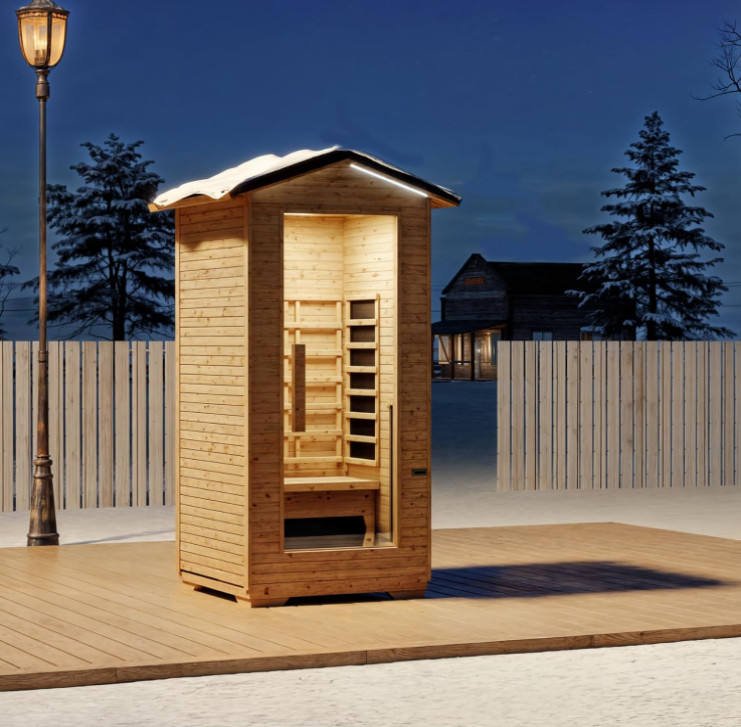
- Confirm whether the model is rated for outdoor placement. An indoor cabin sited outside will not be covered by warranty and will not survive weather exposure.
- Think about where the sauna sits relative to the shower. A cold rinse or plunge immediately afterwards is the most common way people actually use a home sauna, and a long walk between them discourages it.
Electrical, ventilation, drainage, and structural requirements
- Electrical. Confirm the exact circuit requirement before purchase and have a licensed electrician verify your panel capacity. A dedicated circuit is common. This is the most frequent cause of a delayed installation, and retrofitting a circuit after delivery is significantly more expensive than planning for it.
- Ventilation. Infrared cabins produce no steam, but they do put heat and perspiration moisture into the room. A room with no air exchange will hold humidity. A bathroom-grade extract fan, an openable window, or an HVAC return in the room is usually sufficient.
- Moisture and finishes. Sweat reaches the floor. Sealed flooring under and immediately around the cabin protects the substrate; unsealed timber and some laminates do not tolerate repeated wetting.
- Structural. Check floor loading for upper-storey and timber-framed installations, taking assembled weight plus occupants.
- Drainage. Not required for an infrared cabin. If you are planning a cold plunge in the same room, the drainage requirement comes from that appliance and should be planned at the same time.
Maintenance and sanitation
- Wipe benches and backrests down after each session. Untreated sauna wood should not be sealed or varnished — it is intended to breathe — so a damp cloth and time to dry is the correct routine.
- Use bench towels. They are the single most effective thing you can do to extend the life of the interior.
- Leave the door ajar after use so the cabin dries out rather than staying closed and damp.
- Vacuum the floor and check emitter faces periodically for dust, which affects output.
- Expect to replace emitters eventually. Ask what the expected service life is and whether individual emitters can be replaced without returning the cabin.
Residential versus commercial use
A residential cabin is designed for a few sessions a day at most. In a gym, studio, spa, or hotel, the same cabin may be asked to run for ten or twelve hours continuously with a new occupant every half hour, and residential cabinetry, benches, and controls are not built for that. Commercial installations also carry obligations a home does not: accessibility, timers with automatic shut-off, occupancy signage, cleaning protocols between users, and in many jurisdictions inspection. If the equipment will be used by anyone other than your household, specify it as commercial from the outset — see IMPERVITA PRO.
Warranty and service questions to ask
- What exactly is covered, and for how long, on each of: cabinetry, heaters or emitters, controller, and electronics? These frequently carry different terms in the same warranty.
- Is the warranty transferable if you sell the house?
- Does the warranty require professional installation, and does self-assembly void any part of it?
- Are replacement emitters and controllers stocked, and for how many years after the model is discontinued?
- Who performs a warranty repair — the manufacturer, a local technician, or you with a shipped part?
- What is explicitly excluded? Outdoor placement of an indoor unit, humidity damage, and commercial use in a residential cabin are the usual exclusions.
- Who pays freight on a warranty replacement, and does the labour to fit it count as covered?
What the evidence shows
Regular sauna bathing has been studied extensively, most notably in a long-running Finnish cohort that reported an inverse association between sauna frequency and fatal cardiovascular events, and in systematic reviews of dry sauna bathing across cardiovascular and musculoskeletal outcomes. Research has also examined passive body heating before bed in relation to sleep onset. Evidence suggests a consistent physiological response to repeated heat exposure — cardiovascular, thermoregulatory, and perceptual — and the effects reported are generally associated with regular rather than occasional use.
Sources in the IMPERVITA Research Library:
- Cardiovascular and Other Health Benefits of Sauna Bathing: A Review of the Evidence Laukkanen JA, Laukkanen T, Kunutsor SK · 2018
- Association Between Sauna Bathing and Fatal Cardiovascular and All-Cause Mortality Events Laukkanen T, Khan H, Zaccardi F, Laukkanen JA · 2015
- Clinical Effects of Regular Dry Sauna Bathing: A Systematic Review Hussain J, Cohen M · 2018
- Far-Infrared Saunas for Treatment of Cardiovascular Risk Factors: Summary of Published Evidence Beever R · 2009
- Before-Bedtime Passive Body Heating by Warm Shower or Bath to Improve Sleep: A Systematic Review and Meta-Analysis Haghayegh S, Khoshnevis S, Smolensky MH, Diller KR, Castriotta RJ · 2019
- NFPA 70 — National Electrical Code National Fire Protection Association · Current edition
What the evidence does not establish
The great majority of that research studied traditional Finnish saunas, not infrared cabins, and the two differ in air temperature, humidity, and how heat is delivered. The strongest findings come from observational cohorts, which can show association but cannot establish cause; participants who sauna frequently may differ from those who do not in ways the studies could not fully adjust for. The infrared-specific literature is much smaller, older, and mostly conducted on a small number of systems. The sleep research used warm baths and showers rather than saunas. None of this establishes that an infrared sauna treats, cures, prevents, or mitigates any disease, and it should not be read as a reason to change any medical treatment. Heat exposure is not appropriate for everyone: anyone who is pregnant, has cardiovascular disease, low blood pressure, or a condition affecting heat tolerance, or who is taking medication that affects thermoregulation, should speak to a physician before using a sauna.
Buyer checklist
- Exact voltage and amperage confirmed in writing, and your panel checked by a licensed electrician.
- Interior bench length and interior height checked against the tallest person who will use it.
- Delivery path measured — doorways, stair turns, and corners.
- Manufacturer clearance requirement confirmed against the actual room.
- Emitter layout diagram obtained, not just an emitter count.
- Wood species chosen with scent sensitivity in mind.
- Room ventilation and floor protection planned.
- Warranty terms read for cabinetry, emitters, and controller separately.
- Parts availability and warranty labour arrangements confirmed.
- If anyone outside your household will use it, specified as commercial.
Information provided by IMPERVITA is for educational and general wellness purposes and is not intended to replace professional medical advice, diagnosis, or treatment.