Cold Plunge Systems

Ice is what kills a cold plunge habit — a standing weekly cost, a different temperature every session, and twenty minutes of preparation you often decide you do not have. A chilled, filtered system removes all of that: the water is already cold when you walk up to it. Choose on two questions. Do you already own a tub, in which case a chiller is by far the cheapest route to daily cold water? And do you want cedar or acrylic, with the chiller included or added later? An advisor will confirm compatibility, supply and placement before your order is released.

Showing all 5 results

Almost everyone who buys a cold plunge has already tried the ice-bath version and given up on it. The equipment is not really solving cold; it is solving the logistics that made cold unsustainable — the ice runs, the water changes, the smell, the three days it sat unused because refilling it was a chore.

That reframing matters because it changes which specifications you should care about. The variable that decides whether a plunge gets used is not how cold it can theoretically go. It is how quickly it recovers temperature, and how little effort it takes to keep the water clean.

Why buyers consider Cold Plunge Systems

  • A chilled, filtered, covered vessel holds temperature continuously, so cold immersion becomes a five-minute decision rather than an hour of preparation.
  • Temperature is set and repeatable, which matters if you want to progress gradually or keep sessions consistent.
  • Filtration and sanitation mean the same water lasts weeks or months rather than being dumped after every use.
  • Pairing a plunge with a sauna is the most common reason people buy one, and the contrast pairing is the form of cold exposure with the most directly relevant research.

What to compare before buying

Complete system versus vessel plus chiller
A complete system arrives matched — vessel, chiller, filtration, and controls engineered together, with one warranty and one support contact. A separate vessel and chiller can be cheaper and more flexible, but you own the integration: matching chiller capacity to water volume and insulation, plumbing the loop, and dealing with two manufacturers if something fails. Buy a complete system unless you have a specific reason not to.
Chiller capacity against water volume
This pairing decides everything about how the plunge behaves. An undersized chiller on a large, poorly insulated tub will hold temperature in a cool room and lose the argument in a hot garage in August. Ask for the temperature the system can maintain at a stated ambient temperature, not just the minimum temperature it can theoretically reach.
Recovery rate
How quickly the system returns to setpoint after someone has been in it. In a household this is a convenience question. With several users back to back it becomes the specification that determines whether the plunge works at all.
Filtration and sanitation approach
Options generally combine a mechanical filter with ozone, UV, or a chemical residual. Ozone and UV treat water as it passes through the system; neither leaves a residual in the tub, so many systems pair them with a low chemical residual. Understand which combination you are buying and what the ongoing routine and consumable cost is.
Insulation
Insulation quality shows up on the electricity bill every month rather than on the invoice once. A well-insulated vessel with a fitted, insulated cover asks far less of the chiller.
Entry and exit
Step height, grab points, and floor grip. Getting out of cold water is when balance is worst, and this is rarely mentioned in a specification sheet.

The specifications that actually matter

Water volume
Drives chiller sizing, filled weight, chemical dosing, and heat-up and cool-down time.
Filled weight
The number that decides where the plunge can go. Water weighs roughly 8.34 pounds per US gallon, so a 100-gallon plunge is already over 800 pounds of water before the vessel and the occupant. On any upper floor, deck, or timber-framed structure this needs checking against the floor loading, and a structural engineer should confirm anything marginal.
Minimum temperature and maintained temperature at ambient
Two different figures. The second is the honest one and the one to ask for.
Electrical requirement
Chillers commonly need a dedicated circuit, and equipment near water carries additional protection requirements. Confirm the circuit before purchase and have a licensed electrician verify it against the applicable code.
Noise level
A chiller is a refrigeration unit with a compressor and a fan. It runs periodically, including at night. Ask for a decibel figure and think about where it sits relative to bedrooms and neighbours.
Drain arrangement
How the vessel empties, where that water goes, and how long a full drain and refill takes.

Space and installation

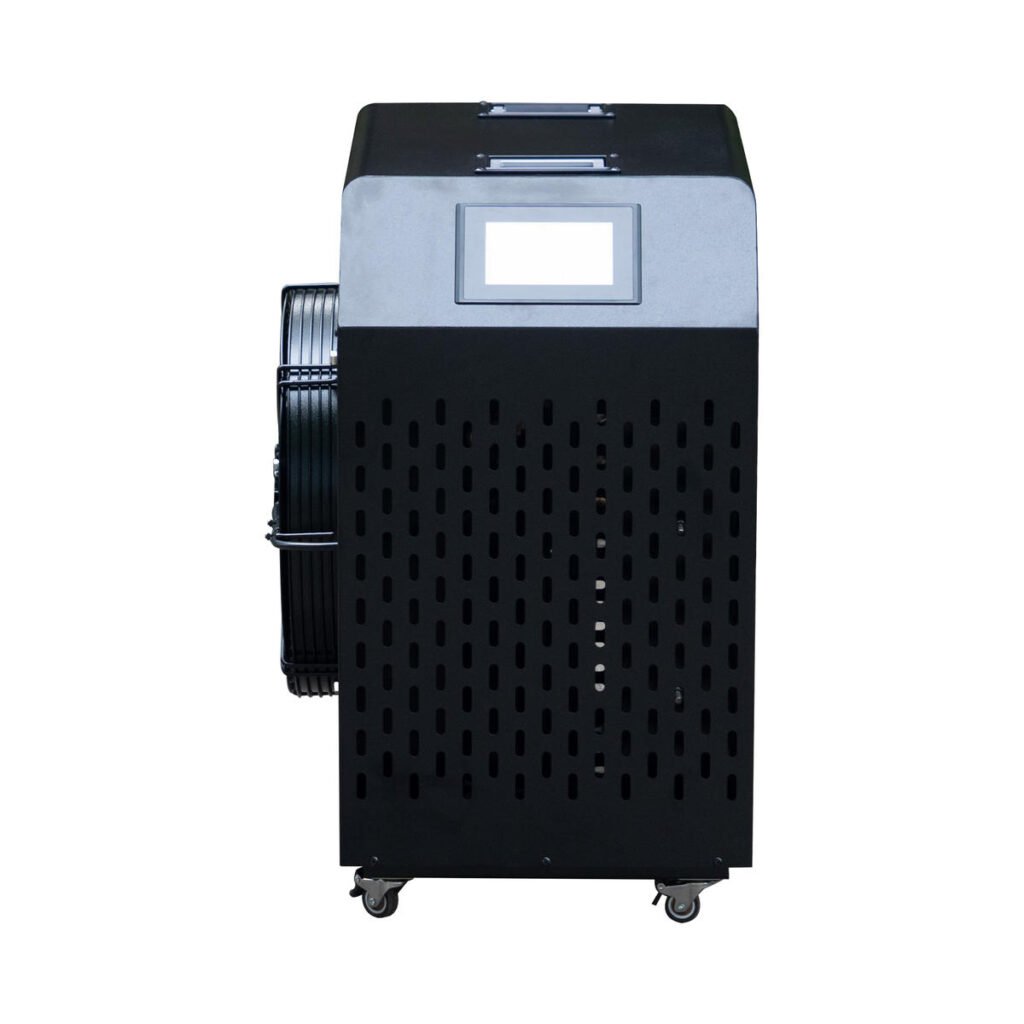
  • Plan for the chiller as a separate object. It needs its own footprint, clear airflow around it, and service access — it cannot be boxed into a cupboard without ventilation.
  • Leave working room around the vessel for filter changes and water testing, not just for the person getting in.
  • Check filled weight against floor loading for any installation not on a ground-bearing slab.
  • Plan the wet path: where someone stands dripping when they get out, and what that flooring is. Non-slip is a safety requirement here, not a finish preference.
  • For outdoor installation, confirm the unit and chiller are rated for outdoor use and for your winter and summer extremes. Freezing conditions require a documented winterisation procedure.

Electrical, ventilation, drainage, and structural requirements

  • Electrical. Confirm the circuit requirement in writing. Equipment in and around water is subject to specific protection requirements under the applicable electrical code, and a licensed electrician must confirm what your installation needs.
  • Drainage. Decide before delivery where several hundred gallons will go when the tub is emptied. A floor drain, a nearby gully, or a pump-out route all work; discovering there is no route on the day does not.
  • Structural. Filled weight plus occupant, checked against the floor. This is the most commonly skipped step for basement, garage, and upper-floor installations.
  • Ventilation. The chiller rejects heat into the room it sits in. In a small enclosed space it will warm that room and then work harder against its own exhaust. Give it airflow.
  • Water supply. Not usually plumbed in, but a hose route for filling makes the difference between a fifteen-minute refill and an afternoon.

Maintenance and sanitation

  • Test and record water chemistry on a regular schedule. Cold water slows biological growth but does not stop it, and a plunge is a small volume of water with a high bather load relative to its size.
  • Rinse before entering. It is the cheapest water-quality intervention available and it materially extends the interval between water changes.
  • Clean or replace mechanical filters on the manufacturer schedule.
  • Keep the cover on. It reduces energy use, keeps debris out, and is a safety measure where children have access.
  • Replace ozone or UV components on schedule — they degrade quietly, and water quality falls before anything visibly fails.
  • Drain, clean, and refill at the interval the manufacturer specifies, and confirm what that interval actually is before you buy.

Residential versus commercial use

Residential plunges are specified for a handful of sessions a day. A studio or gym running sessions continuously puts a fundamentally different demand on the chiller, the filtration, and the sanitation regime: recovery rate becomes the limiting specification, filtration must handle a far higher bather load, and most jurisdictions apply public-bathing water-quality rules that a home is not subject to. Commercial operators should also plan for scheduled downtime, since a plunge cannot be cleaned and used at the same time. Specify commercial equipment from the start rather than discovering the limit in month two — see IMPERVITA PRO.

Warranty and service questions to ask

  • Are the vessel, the chiller, and the pump covered for the same period? They usually are not, and the chiller is the expensive part.
  • Is the compressor covered separately, and for how long?
  • What voids the warranty — running outside the stated ambient range, incorrect water chemistry, freezing, or commercial use of a residential unit?
  • Who services the chiller, and is there a technician within reasonable distance?
  • Are seals, pumps, filters, and ozone or UV components stocked as replacement parts?
  • Is water chemistry documentation required to make a claim? Some manufacturers require test records.
  • Who pays freight on a warranty replacement of a heavy item?

What the evidence shows

Cold-water immersion is among the more heavily studied recovery methods. A recent systematic review and meta-analysis examined its effects on health and wellbeing in healthy adults, and a Cochrane review assessed it for delayed-onset muscle soreness after exercise. Contrast water therapy — alternating heat and cold — has been examined in its own meta-analysis, which is the most directly relevant evidence for the common sauna-and-plunge pairing. Broader comparisons of post-exercise recovery methods place cold immersion alongside massage, compression, and active recovery on shared outcome measures. Evidence suggests short-term effects on perceived soreness and fatigue, with results depending heavily on water temperature, duration, and timing.

Sources in the IMPERVITA Research Library:

What the evidence does not establish

Effects reported are generally modest, often short-lived, and measured mostly as biochemical markers or self-reported soreness rather than long-term health outcomes. Protocols vary widely between studies, so there is no established optimal temperature or duration. One controlled trial found that cold immersion immediately after resistance training blunted muscle adaptation over twelve weeks — relevant to timing rather than to whether to own one, but it does mean cold immediately after lifting may work against a strength goal. Several frequently repeated claims about metabolism, immunity, and brown fat rest on preliminary or contested evidence, and reviews in this area explicitly describe the field as unsettled. None of this establishes that cold immersion treats or prevents any disease. Cold immersion also carries genuine physiological risk: the cold shock response causes involuntary gasping, hyperventilation, and a sharp increase in cardiac load. Never plunge alone, never immediately after alcohol, and anyone with cardiovascular disease, high blood pressure, a heart rhythm disorder, Raynaud phenomenon, or who is pregnant should speak to a physician first.

Related technologies

Buyer checklist

  • Maintained temperature at your actual ambient conditions confirmed — not just minimum temperature.
  • Recovery rate confirmed, and checked against how many people will use it back to back.
  • Filled weight calculated and checked against floor loading.
  • Drain route decided before delivery.
  • Electrical circuit confirmed in writing and verified by a licensed electrician.
  • Chiller location chosen with airflow, service access, and noise in mind.
  • Sanitation approach understood, including consumable cost and replacement intervals.
  • Non-slip surface planned for the wet exit path.
  • Cover included and specified as insulated.
  • Winterisation procedure obtained if the unit will be outdoors.

Water volume, ambient temperature, and how many people will use it are the three answers an advisor needs to tell you which systems will actually hold temperature where you intend to put it.

Speak With a Wellness Advisor Narrow it down in four questions

Information provided by IMPERVITA is for educational and general wellness purposes and is not intended to replace professional medical advice, diagnosis, or treatment.

Scroll to Top