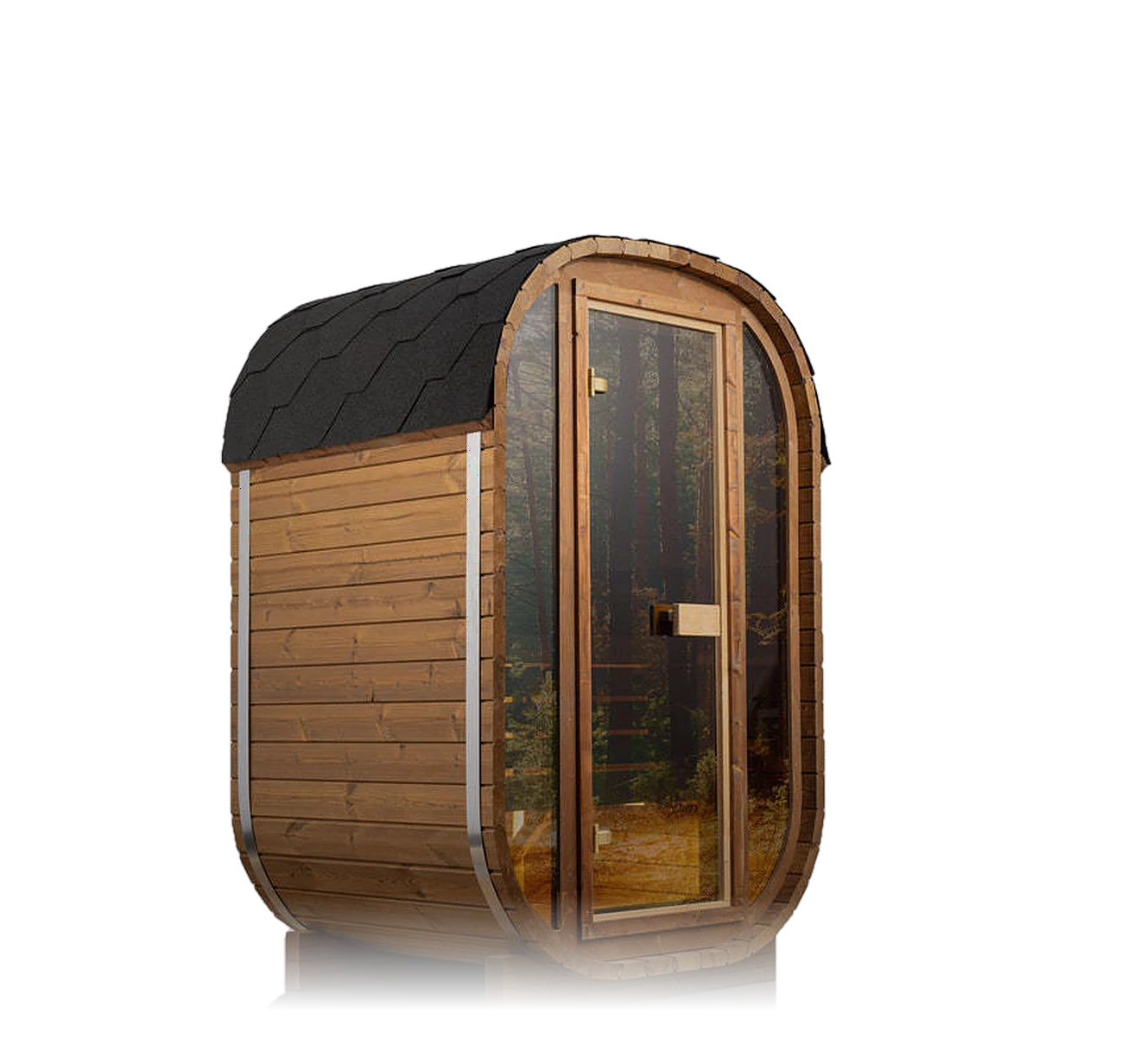
Saunas
Two kinds of sauna. The difference is not the temperature.
IMPERVITA carries infrared cabins and traditional heater-and-stones saunas. They are different appliances that happen to share a shape, they ask very different things of your home, and which one you choose decides everything that follows.
Settle the heat type before you look at size or price
Almost everyone starts by comparing cabins on capacity, timber and price. Those are the easiest things to compare and the least predictive of whether the sauna still gets used in three years. The decision that actually matters is how the heat is made, because it changes the session itself, the electrical supply, the room or base it needs, and whether the cabin can make steam at all.
It is also the one decision that cannot be revised afterwards. A cabin cannot be converted from one type to the other.
Infrared cabins
Emitters in the cabin walls radiate far-infrared energy the body absorbs directly, so the cabin runs at a much lower air temperature than a traditional sauna and reaches it faster. Most are freestanding and plug into a room that already exists, which makes them the least invasive way into a near-daily heat habit.
- Lower air temperature and a longer comfortable session, with a shorter heat-up.
- No plumbing and no drain, and often no electrical work beyond an ordinary outlet.
- Cannot produce steam at any setting. If humid heat is what you picture, this is not the cabin.
- Sized from one person up to three, indoors, or outdoors where the manufacturer rates that specific model for it.
Browse the range in infrared saunas, where the buying guide covers emitter layout, cabin sizing and the circuit requirement that stalls more installations than anything else.
Traditional and outdoor cabins
A traditional sauna holds a bed of stones at temperature with a heater. The cabin warms by convection and radiant heat, reaches a much higher air temperature, and water poured over the stones lifts the humidity for a short, sharper burst. That steam is the part of a sauna an infrared cabin cannot reproduce. These are outdoor cabins here, sited on a prepared base rather than dropped into a spare room.
- Genuine heater-and-stones heat, with humidity you control by how much water you pour.
- Needs a prepared, level, load-bearing base, and usually a dedicated outdoor circuit.
- Wood-burning is available from some manufacturers on request, which removes the electrical demand and adds a flue, clearances and often a permit.
- Sized for one or two people up to three or four, so a household uses it together rather than in shifts.
Browse the range in outdoor and traditional saunas, where the buying guide covers heat type, base preparation, the outdoor supply and the delivery route.
What each one asks of your home
This is where the two diverge most, and where budgets are usually wrong. An indoor infrared cabin is close to an appliance purchase. An outdoor traditional cabin is a small building project, and the groundworks and the electrical run are part of the cost rather than extras.
- Electrical. Many indoor infrared cabins run from an ordinary outlet. A traditional electric heater commonly needs a dedicated higher-capacity circuit run outdoors, which is an electrician job and often a trenching job.
- Base or floor. An indoor cabin needs a level floor and sealed finishes beneath it. An outdoor cabin needs a prepared, load-bearing base built to the manufacturer specification.
- Ventilation and moisture. An indoor cabin puts heat and perspiration moisture into the surrounding room. An outdoor cabin vents to open air and takes that problem away entirely.
- Delivery route. Cabins arrive as large rigid panels by freight. Doorways, stair turns, gate widths and level changes decide whether the cabin can physically reach where it is going.
- The cold end. Most people finish a sauna with a cold rinse or plunge. Where that sits relative to the cabin is worth deciding before anything is ordered, not after.
Narrow it down by who is using it
- One regular user, indoors: 1-person infrared saunas.
- Two people, indoors: 2-person infrared saunas.
- Three, or room to lie down: 3-person infrared saunas.
- Infrared, but outside: outdoor-rated infrared saunas.
- Traditional heat for one or two: 1-2 person outdoor saunas.
- Traditional heat for a household: 3-4 person outdoor saunas.
Common questions
Which is better, an infrared or a traditional sauna?
Neither. They are different appliances. A traditional sauna reaches a much higher air temperature and can make steam by pouring water over hot stones; an infrared cabin runs cooler and drier and warms the body directly, and cannot make steam at all. Choose on the session you want and on what your home can supply, not on which sounds more advanced.
Does an infrared sauna need special wiring?
Often not. Many one and two person indoor infrared cabins run from an ordinary household outlet, and some larger cabins need a dedicated circuit. A traditional electric heater is a different matter and commonly needs a dedicated higher-capacity circuit run to an outdoor location. Get the exact requirement in writing and have a licensed electrician confirm your supply before ordering.
Can I put an indoor sauna outside?
No. An indoor cabin sited outdoors will not be covered by its warranty and will not survive weather exposure. Outdoor rating is a specification set by the manufacturer for a specific model, not a placement decision, so confirm it for the exact cabin rather than assuming it applies to the whole range.
How much space does an outdoor sauna need?
More than the cabin footprint. You need the manufacturer clearance on every side, a prepared level base able to carry the assembled weight plus occupants, and a delivery route wide enough for large rigid panels to reach it. The base and the access route are the two things most often left out of a plan.
How long does a sauna take to heat up?
It varies by cabin and heat type, and it predicts how often the sauna actually gets used better than almost any other published figure. A cabin that takes 45 minutes tends to be used at weekends; one that takes 20 gets used on weekdays. Ask for the figure for the specific model.
Still weighing the two? The journal covers infrared versus traditional saunas and what low EMF actually means. For heat and cold in one room, see recovery rooms.
Tell an advisor the room or the outdoor space, the supply available and who will use it, and we will tell you which of the two makes sense, including when the answer is neither yet.
 Wellness • Recovery • Longevity
Information provided by IMPERVITA is for educational and general wellness purposes and is not intended to replace professional medical advice, diagnosis, or treatment.